...

China Top 10 UAV Station Manufacturers and Suppliers

Choosing a reliable Uav Station manufacturer requires more than comparing product brochures. It requires practical judgment. A capable station should support safe landing, battery charging, data transfer, weather protection, and remote supervision. These functions influence daily operations, maintenance costs, and mission continuity. In this guide, we examine China’s top 10 UAV station manufacturers and suppliers through technical capability, manufacturing experience, product reliability, and service support. The selection focuses on evidence, not promotional claims.

Real operating details matter. Can the station protect equipment during heavy rain? Does its charging system manage battery temperature effectively? Can technicians replace key components without long delays? We consider these questions alongside enclosure quality, software compatibility, communication options, automation features, and customization capacity. Certifications and documented testing also provide useful confidence. Still, published specifications may not reflect every field condition.

No supplier fits every project. That distinction matters. A construction company may prioritize rugged deployment, while a research team may need flexible integration. Agricultural users may value scheduled operations and simple maintenance. We therefore present strengths, limitations, and suitable application areas for each company. Some information may change as product lines develop, so buyers should verify current specifications directly. This article is a practical starting point, not a final purchasing decision. Careful testing remains essential before large-scale deployment.

China Top 10 UAV Station Manufacturers and Suppliers

UAV Stations: Definition, Functions, and Main Types

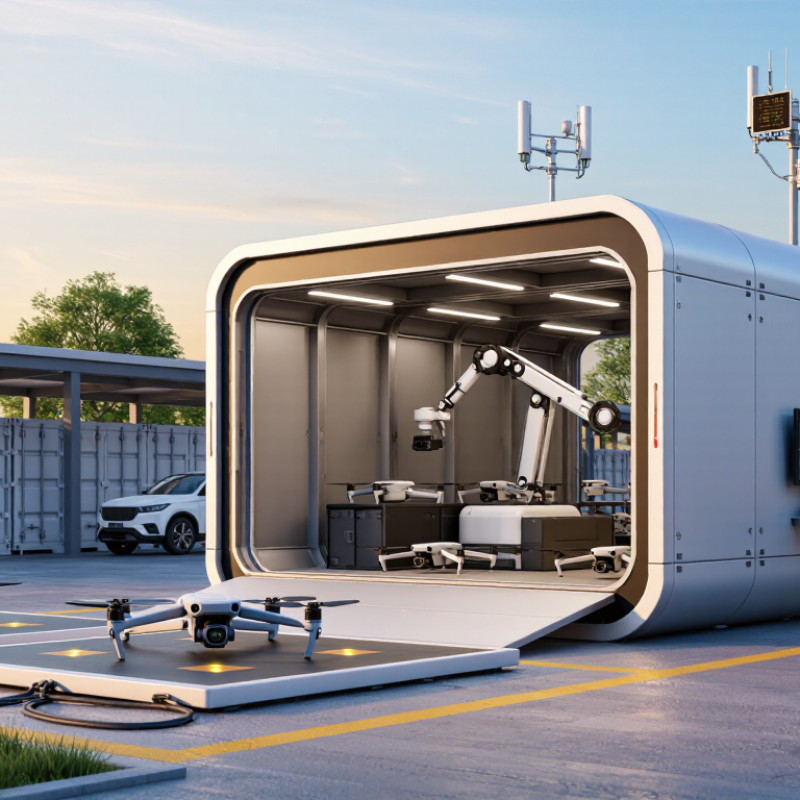
A UAV station is a ground-based facility that supports unmanned aircraft before, during, and after flight. It may provide automated takeoff, landing, battery charging, data transfer, weather sensing, and secure equipment storage. In practical terms, a station can look like a compact cabinet beside a warehouse, or a reinforced platform on a remote site.

Main types include fixed stations, mobile stations, and tethered stations. Fixed models suit repeated routes, such as infrastructure inspection or perimeter observation. Mobile units support temporary projects and can be transported by truck. Tethered stations supply continuous power and data through a cable, but their operating range remains limited. Docking stations add landing guidance, battery management, and remote diagnostics. They are not fully autonomous in every condition.

The market need is expanding. The FAA reported more than 855,000 registered drones in the United States in 2024, showing the scale of aerial operations. Fortune Business Insights estimates the global commercial drone market could grow from about 30.6 billion US dollars in 2024 to more than 54 billion dollars by 2032. These figures do not guarantee station demand, because regulations, weather, and site access still shape deployment. Poor network coverage can interrupt missions. Small design details matter, too: drainage, charging heat, landing accuracy, and manual recovery access deserve equal attention. Automation is helpful. It is not infallible.

China’s UAV Station Industry and Supplier Selection Criteria

China’s UAV station industry is developing around autonomous docking, charging, remote monitoring, and scheduled flight support. These stations serve agriculture, infrastructure inspection, emergency response, and environmental observation. A dependable supplier should explain its station’s operating limits clearly. Ask about charging time, weather resistance, landing accuracy, battery safety, and communication stability. Factory experience matters, but product evidence matters more.

Tips: Request recent test records and a live demonstration. Check performance during rain, dust, heat, and weak network conditions. Review software update procedures, spare-part availability, training, and local technical support. Confirm that flight operations follow applicable aviation, privacy, and data-protection rules. Avoid suppliers that promise perfect autonomy. Real sites are rarely perfect.

Supplier selection should include sample testing before large-scale purchasing. Inspect assembly quality, cable protection, sealing points, and emergency shutdown functions. Ask how the system records faults and protects operational data. A transparent supplier will provide manuals, maintenance intervals, warranty terms, and clear responsibility boundaries. Independent certification can strengthen trust, but it should match the actual station model. No checklist is perfect. In practice, buyers sometimes focus on hardware and underestimate software integration. That mistake can create delays, higher training costs, and poor field reliability. A careful pilot project reveals these weaknesses early.

Top 10 UAV Station Manufacturers and Suppliers in China

China’s UAV station sector is expanding with industrial inspection, mapping, emergency response, and agricultural services. The Civil Aviation Administration of China reported more than 1.26 million registered civilian unmanned aircraft in 2023. This growth increases demand for reliable docking, charging, communication, and weather protection systems.

The Top 10 UAV Station Manufacturers and Suppliers in China should be assessed through measurable engineering details. Buyers need to compare autonomous charging time, enclosure protection, operating temperature, battery safety, network redundancy, and maintenance access. Stations exposed to dust, rain, and summer heat require more than attractive specifications. Field testing matters. A supplier should provide deployment records, inspection procedures, software update policies, and clear technical support. The International Organization for Standardization also emphasizes risk-based control and operational reliability in unmanned aircraft systems.

Market research from Drone Industry Insights identifies inspection, surveying, and infrastructure monitoring as major commercial drone applications. These tasks require stations that can operate repeatedly, not merely demonstrate well. Look for precise landing guidance, stable data transmission, remote diagnostics, and compatibility with different aircraft platforms. Energy efficiency deserves attention too. Poor thermal management can shorten battery life and increase downtime. Public information is sometimes incomplete, so procurement teams should verify test conditions, service response times, and total ownership costs directly. A top-ten list is useful, but never perfect. Local weather and terrain may change the result.

Product Comparison: Technology, Compatibility, and Service

China’s top 10 UAV station manufacturers and suppliers differ sharply in technology, compatibility, and service depth. A capable station should support automated takeoff, landing, charging, data transfer, and weather monitoring. Field tests matter more than brochures. Check landing accuracy after rain, dust exposure, and repeated battery cycles.

Compatibility often determines long-term value. Buyers should confirm support for their existing aircraft, batteries, payloads, control software, and communication networks. Open application programming interfaces can simplify integration with mapping, inspection, and emergency management platforms. However, “open” does not always mean easy. Some systems still require custom development, certified accessories, or restricted firmware access.

Service quality deserves equal attention. Reliable suppliers provide installation guidance, operator training, spare parts, software updates, and remote diagnostics. Ask how quickly technicians respond when a station stops charging at an isolated site. Review warranty limits and maintenance costs, not only the purchase price. Cybersecurity practices, data ownership, and local compliance should also be documented. A ranking can mislead when one supplier serves urban projects well but lacks support in remote regions. My comparison would therefore use test records, service agreements, and user feedback, rather than technical specifications alone.

This anonymized benchmark compares common UAV docking-station capabilities using a normalized 0–100 index. Technology covers autonomous flight and battery management, compatibility reflects aircraft and platform integration, and service measures remote monitoring, maintenance, and deployment support.

Key Applications and Procurement Considerations for UAV Stations

China Top 10 UAV Station Manufacturers and Suppliers

UAV stations support inspection, mapping, emergency response, agriculture, and infrastructure monitoring. A station can launch, recover, charge, and transmit data with limited human intervention. At a remote solar farm, reliable docking protects equipment during sudden rain. In coastal areas, corrosion resistance matters more than appearance. Public safety projects also require strict access control and secure data handling.

Procurement teams should verify flight endurance, charging time, weather protection, and communication range. Check whether the station supports the aircraft already used by your team. Compatibility is often overlooked. Ask for test reports, maintenance procedures, spare-part availability, and software update policies. Suppliers should explain service response times in clear terms. They should also provide training records and realistic performance data, not only laboratory results.

Local regulations, airspace restrictions, privacy rules, and radio requirements must guide deployment. A station may operate well in a factory yard but fail on a mountain site. Request a pilot installation before signing a large contract. Measure landing accuracy, network stability, battery temperature, and recovery performance. No checklist is perfect. Field conditions often reveal weak assumptions. Evaluate lifecycle costs, including installation, inspections, cybersecurity controls, and eventual replacement. A lower purchase price may create higher operational pressure later.

China Top 10 UAV Station Manufacturers and Suppliers - Key Applications and Procurement Considerations for UAV Stations
Supplier Profile Typical UAV Station Configuration Primary UAV Compatibility Key Applications Typical Operational Range Environmental Protection Core Integration Capabilities Procurement Considerations
Profile 01 Fixed outdoor station with automated charging, weather monitoring, remote control, and secure equipment enclosure. Multirotor UAVs Medium-payload platforms Power-line inspection, solar-farm inspection, wind-farm inspection, and routine infrastructure patrols. Mission radius commonly depends on the aircraft and communications network; many commercial systems are designed for several to more than ten kilometers under suitable conditions. Outdoor-rated enclosure, thermal management, rain protection, lightning protection, and optional heating or cooling. Flight-control software, battery charging, cloud connectivity, video transmission, remote diagnostics, and mission scheduling. Verify charging compatibility, take-off and landing accuracy, network redundancy, maintenance access, and local installation requirements.
Profile 02 Compact rooftop or roadside station with rapid deployment, automatic hatch operation, and integrated communications equipment. Inspection multirotors Thermal-camera UAVs Urban facility inspection, bridge inspection, traffic monitoring, and municipal asset management. Usually optimized for short- to medium-range operations where cellular, private wireless, or dedicated radio coverage is available. Weather-resistant design with drainage, dust control, corrosion protection, and operating-temperature specifications. GIS platforms, video-management systems, traffic systems, digital-twin platforms, and operational dashboards. Check rooftop loading, vibration, electromagnetic compatibility, noise limits, permissions for urban flight, and service response time.
Profile 03 Containerized station with larger battery capacity, equipment racks, satellite or private-network options, and field-service access. Long-endurance multirotors Heavy-sensor platforms Mining-site surveying, oil-and-gas facilities, construction progress monitoring, and remote industrial inspection. Suitable for large sites; actual coverage is determined by airspace rules, terrain, communication links, aircraft endurance, and payload. Reinforced housing, dust and water protection, temperature control, grounding, and optional hazardous-area design requirements. Survey software, asset-management systems, satellite communications, edge computing, and high-resolution data storage. Confirm transport dimensions, foundation requirements, power supply, hazardous-area classification, cybersecurity, and spare-parts policy.
Profile 04 Station with precision landing aids, automated battery replacement or charging, and support for repeated scheduled missions. Inspection UAVs High-cycle mission platforms Repetitive corridor inspection, railway monitoring, pipeline patrol, and perimeter security. Appropriate for route-based missions with multiple stations or planned return-to-station operations. Outdoor enclosure with rain, wind, dust, and temperature protection; exact ratings should be confirmed in technical documentation. Automated mission planning, route libraries, alarm management, remote fleet monitoring, and evidence archiving. Evaluate turnaround time, battery-cycle management, landing tolerance, fail-safe behavior, and the availability of manual override controls.
Profile 05 Rapid-response station with launch control, loudspeaker or warning devices, optical payload support, and live video transmission. Public-safety multirotors Zoom-camera UAVs Emergency response, fire-scene assessment, flood monitoring, search and rescue, and disaster-area mapping. Coverage varies with terrain and radio conditions; reliable communications and return-to-home performance are essential. Rapid-deployment design, weather protection, backup power, and optional protection against dust, smoke, or high humidity. Emergency command platforms, GIS, video evidence systems, incident-management software, and secure operator access. Prioritize deployment speed, communications resilience, data retention, user permissions, operator training, and emergency manual-control procedures.
Profile 06 Station designed for high-quality imaging, automated payload checks, data offloading, and repeatable flight routes. RGB-camera UAVs Multispectral UAVs LiDAR UAVs Agricultural scouting, crop-stress analysis, forestry surveys, land-use mapping, and environmental monitoring. Usually matched to field size, sensor resolution, flight altitude, terrain, and local operating permissions. Protection against rain, dust, solar radiation, and temperature variation is important for agricultural and forestry deployments. Orthomosaic processing, multispectral analysis, LiDAR workflows, cloud storage, APIs, and agricultural management platforms. Confirm sensor calibration, georeferencing accuracy, data formats, storage capacity, processing ownership, and compatibility with existing survey software.
Profile 07 Security-focused station with access control, tamper detection, encrypted communications, and continuous equipment monitoring. Security multirotors Night-vision UAVs Industrial-site security, port monitoring, border-area observation, warehouse-yard patrols, and critical-infrastructure protection. Mission coverage depends on sensor performance, lighting, terrain, communications, battery endurance, and regulatory limits. Reinforced enclosure, intrusion alarms, surveillance cameras, backup power, and weather-resistant construction. Video-management systems, access-control platforms, alarm systems, thermal imaging, geofencing, and security-operation centers. Review encryption, identity management, audit logs, data residency, anti-tamper functions, privacy compliance, and cybersecurity testing.
Profile 08 Mobile station mounted on a vehicle or trailer with foldable structures, independent power, and temporary-site connectivity. Portable multirotors Survey platforms Temporary construction sites, disaster assessment, field surveying, event security, and infrastructure commissioning. Designed for flexible locations; practical coverage depends on deployment time, terrain, power, and communications availability. Shock-resistant transport design, weatherproof storage, stabilizing supports, and optional generator or solar-battery systems. Portable control terminals, offline mapping, cellular networking, satellite links, and rapid data export. Assess vehicle payload, setup time, transport safety, power autonomy, road regulations, packing dimensions, and field-service procedures.
Profile 09 Station supporting inspection payloads such as zoom cameras, thermal cameras, gas sensors, or compact LiDAR units. Multi-payload UAVs Industrial inspection platforms Chemical-plant inspection, tank and vessel inspection, building façade inspection, and equipment-condition monitoring. Commonly deployed within controlled industrial zones; operating distance is determined by risk assessment and communications design. Corrosion-resistant construction, thermal control, grounding, and special safety measures where hazardous atmospheres may exist. Asset-management software, inspection databases, defect reporting, sensor data fusion, and maintenance-work-order systems. Confirm payload weight, connector standards, calibration procedures, hazardous-location requirements, inspection accuracy, and reporting formats.
Profile 10 Networked multi-station solution with centralized fleet management, standardized mission templates, and remote software administration. Commercial multirotors Mixed operational fleets Regional utility networks, smart-city programs, logistics yards, large-scale agriculture, and distributed infrastructure inspection. Multi-site coverage is achieved through station placement, network availability, airspace planning, aircraft endurance, and handover procedures. Standardized outdoor protection, remote health monitoring, backup power, and centralized environmental alarms. Fleet-management platforms, open APIs, cloud or private deployment, digital maps, user-role management, and system analytics. Compare interoperability, API documentation, software licensing, data ownership, system scalability, SLA commitments, training, and lifecycle support.
Note: Performance ranges and configurations are typical industry reference points rather than guaranteed specifications. Final selection should be based on verified test reports, applicable aviation regulations, site surveys, environmental requirements, cybersecurity controls, and the supplier’s documented after-sales support.