

Choosing the best Fog Fountain requires more than comparing shapes, lights, and water effects. You must match the unit with your space, climate, maintenance capacity, and visitor expectations. A small tabletop model behaves very differently from a commercial installation producing dense mist across a hotel lobby.
Public market reports rarely separate Fog Fountain systems from decorative water features, misting equipment, or indoor environmental products. This limitation matters. Grand View Research and Fortune Business Insights track broader water-feature and humidification markets, but their figures should not be treated as direct Fog Fountain sales data. A careful buyer should examine pump performance, mist output, reservoir capacity, noise levels, energy use, and replacement-part availability.
Air quality deserves equal attention. ASHRAE Standard 62.1 emphasizes adequate ventilation for acceptable indoor air quality, while the U.S. Environmental Protection Agency warns that excessive indoor moisture can encourage mold growth. Dr. William P. Bahnfleth, an indoor-air-quality specialist and former ASHRAE Epidemic Task Force chair, has stressed, “Ventilation is not a magic bullet.” The principle applies here.
A beautiful mist effect can still create problems.
Look closely at the floor around the fountain. Is it slippery? Can staff drain and clean the tank without tools? Does the controller prevent continuous operation when water levels fall? These practical details often matter more than decorative finish. The right Fog Fountain should deliver a convincing atmosphere while remaining quiet, serviceable, and suitable for its environment. Some published specifications are incomplete, so verify claims with the manufacturer before purchasing.
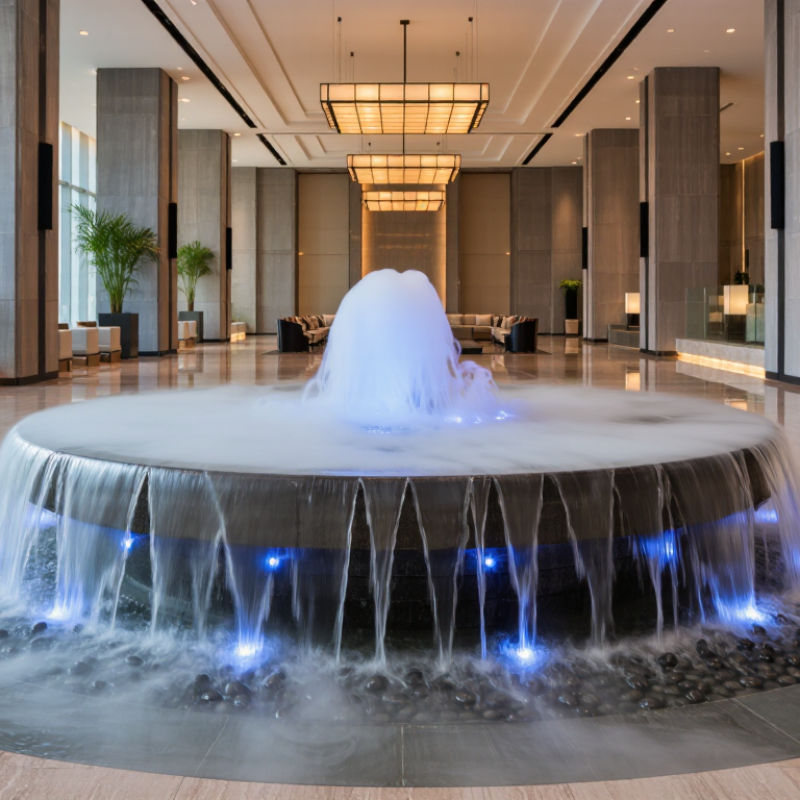
Choosing a fog fountain starts with the visual effect you want. A 1.7 MHz ultrasonic fogger commonly produces droplets around 3–5 μm. These droplets are fine enough to float above the water surface. They can create a soft, cloud-like layer around lights, ornaments, or small waterfalls.
The effect depends on more than frequency. Water temperature, mineral content, airflow, and basin depth all influence fog output. Hard water may leave deposits on the transducer and reduce performance. Filtered or distilled water usually supports cleaner operation.
Keep the water level within the recommended range. Too little water can damage the unit.
A 3–5 μm mist looks delicate, not dramatic. It may disappear quickly in a strong draft. Indoors, a quiet corner often gives better results than an open doorway. Colored lighting can reveal the mist, but excessive brightness may flatten its appearance. This detail is easy to overlook. The stated particle size is also an operating estimate, not a permanent guarantee. Real droplets may vary as the water warms or the transducer ages. Check the mist pattern after several hours, not only during the first test. A fountain that looks perfect in a still showroom may behave differently beside a fan, vent, or moving audience.

Choosing a fog fountain starts with matching mist output to basin volume, not appearance alone. A practical planning range is 0.3–0.5 liters per hour for each fogger head. Four heads therefore produce about 1.2–2.0 liters hourly. That amount can noticeably lower the water line in a shallow basin.
Measure the basin’s usable capacity, not its total shell volume. A 30-liter basin may hold only 20 liters safely, leaving space for ripples and overflow. At 1.6 liters per hour, four mid-range heads could consume roughly 12.8 liters during an eight-hour display. Real loss may be higher outdoors because wind accelerates evaporation. It may also be lower in a cool, enclosed room.
ASHRAE’s 2023 HVAC Applications Handbook identifies air movement, temperature, exposed water area, and humidity as major evaporation factors. These variables matter more than a simple head-count calculation. The U.S. Environmental Protection Agency commonly recommends 30–50% relative humidity indoors, but that range is not a fountain-sizing standard. It still highlights why indoor placement needs careful moisture control.
Use more heads for wider visual coverage, but reduce output when the basin is narrow or shallow. A small basin with excessive fog can empty unexpectedly. It can also leave mineral residue around the rim. That is an easy detail to miss. Check the water level after two hours, then adjust the estimate. My first calculation would not be final. Real conditions deserve a second measurement.
Choosing the best fog fountain starts with water quality, not lighting or pump size. In my installations, mineral-heavy water caused cloudy nozzles, weak mist, and gritty deposits around the basin. Total dissolved solids, or TDS, provide a useful warning. Keep TDS below 100 ppm to limit mineral scale. This is a practical target, not a universal rule. Water temperature, evaporation, and operating hours still affect buildup. Small differences matter.
Test before purchase. Use a calibrated TDS meter and test the actual water source, not a nearby tap. Record the reading at different times, especially after the fountain operates for several hours. TDS meters estimate conductivity, so they cannot identify every mineral or contaminant. A reading below 100 ppm does not guarantee perfect water. That part is easy to overlook.
If your water exceeds the target, consider filtered, reverse-osmosis, or distilled water that suits the fountain’s specifications. Avoid guessing. Check the operating manual for acceptable water conditions and replacement schedules. Clean the basin and misting components regularly, even when the TDS reading looks safe. I once trusted a low reading and delayed cleaning; a thin white film still reduced mist output. That mistake changed my maintenance routine. Keep simple records of TDS, cleaning dates, and visible scale. These details make future fountain choices more reliable.
Total dissolved solids (TDS) are measured in parts per million (ppm), approximately equivalent to milligrams per liter. Keeping fountain water below 100 ppm is a practical operating target for reducing mineral deposits on fog nozzles, pumps, and surrounding surfaces. For comparison, 500 ppm is the U.S. EPA secondary drinking-water standard for TDS and is not a specific fog-fountain scale limit.
TDS is only a screening indicator. Actual mineral scaling also depends on water hardness, alkalinity, pH, temperature, evaporation, and maintenance frequency. Test the water regularly and use filtration or treated water when readings approach or exceed the 100 ppm target.
Energy planning should begin with the ultrasonic head count. Allow 20–40 W of power per ultrasonic head during normal operation. A fountain with three heads may therefore use 60–120 W for mist production alone. Check the equipment label before buying. Real consumption can vary with water depth, control settings, and component efficiency.
Do not confuse head power with the fountain’s total electrical demand. Pumps, lights, fans, and controllers also consume energy. For example, three 30 W heads, a 25 W pump, and a 12 W light require about 127 W together. Running this setup for eight hours uses roughly 1.02 kilowatt-hours. A plug-in energy meter can verify the estimate. This practical check is more reliable than relying only on promotional specifications.
A power supply operating at its limit may run hot and age faster. Selecting about 15–20% extra capacity is a sensible working margin. However, more capacity does not always mean lower energy use. I once estimated consumption from head ratings alone and missed the pump load. That mistake changed the operating cost noticeably. Record actual wattage after installation, especially when the mist output appears weaker than expected. Clean water and correct water levels also help the heads work consistently, although results can still differ between installations.
Choosing a fog fountain requires more than checking its mist output or visual design. Protection matters because water, moisture, and electrical parts often share limited space. Under IEC 60529 criteria, an IP65 rating means the enclosure is dust-tight and protected against water jets. It does not mean the equipment can be submerged.
Ask the supplier for clear test documentation, not only an IP65 label on a product page. Check whether the rating applies to the complete unit, control box, connectors, and cable entries. A poorly sealed cable gland can weaken an otherwise suitable enclosure. Inspect rubber seals for cracks, especially after transport or long outdoor use. Small details matter.
Placement also affects real protection. Avoid directing strong cleaning jets toward openings or control components. Install the fountain on a stable, level base, and keep drainage paths clear. IP65 protects against specified water exposure, not careless installation. I have seen attractive systems fail because cables rested in standing water. That mistake is easy to repeat. Regularly inspect seals, fasteners, and wiring before seasonal operation. If the fountain sits near pools, public walkways, or heavy rain, ask a qualified technician to review the electrical arrangement. The rating is useful evidence, but it is not a substitute for correct installation, maintenance, or local safety requirements.
| Selection Dimension | Recommended Specification or Range | Why It Matters | Verification Method |
|---|---|---|---|
| Enclosure protection | IP65 or higher, assessed under IEC 60529 | IP6X indicates dust-tight protection. IPX5 indicates protection against water jets from any direction. IP65 does not indicate protection against temporary immersion. | Check the permanent product marking, declaration of conformity, and test documentation for the complete assembled enclosure. |
| Installation environment | Indoor or sheltered outdoor area; avoid locations exposed to flooding or standing water unless a separate immersion rating is specified. | Water-jet protection is different from immersion protection. Outdoor exposure also requires suitable materials and cable-entry protection. | Review the installation instructions, drainage design, operating temperature range, and environmental limitations. |
| Fountain basin size | Small: up to 1 m²; medium: 1–4 m²; large: more than 4 m² | Basin volume and surface area affect circulation, fog coverage, refill frequency, and water-treatment requirements. | Measure basin length, width, and operating water depth; calculate volume before selecting the pump and fogging assembly. |
| Water circulation flow | Use the equipment manufacturer’s rated flow; for planning, many decorative systems operate in the approximate range of 5–30 L/min. | Insufficient flow can reduce fog output, while excessive flow can create splash, noise, and unnecessary energy use. | Confirm the pump curve at the required head height and compare it with the nozzle or fogger’s specified flow rate. |
| Fog particle size | For visible suspended fog, select a system with a documented droplet-size range, commonly below 50 μm for fine mist applications. | Smaller droplets remain airborne longer in still conditions; airflow, humidity, and temperature also affect visibility. | Request a technical datasheet stating the measurement method, operating pressure, water quality, and droplet-size range. |
| Water quality | Use clean, filtered water; follow the equipment limit for hardness, dissolved solids, and suspended particles. | Mineral deposits and particles can clog fine fog nozzles, reduce output, and shorten pump service life. | Test the water source and install filtration or a water-treatment system when required by the equipment instructions. |
| Electrical supply | Match the rated voltage and frequency to the installation supply; provide a correctly sized protective device and residual-current protection where required by local rules. | Correct electrical compatibility reduces overheating, nuisance trips, and shock risk in wet locations. | Check the rating plate, power consumption, wiring diagram, earthing requirements, and local electrical code. |
| Cable and gland protection | Use cable glands, connectors, and covers rated for at least the same environmental conditions as the enclosure. | An IP-rated housing can lose its stated protection if cable entries are incorrectly installed or left unsealed. | Inspect seals, gland tightness, unused-entry plugs, cable diameter compatibility, and strain relief. |
| Operating noise | For quiet indoor displays, target a documented sound level of approximately 45–55 dB(A) at the stated measurement distance. | Pump vibration, fan airflow, water impact, and enclosure resonance can affect visitor comfort. | Compare sound measurements made under the same distance, operating mode, and background-noise conditions. |
| Maintenance access | Provide removable filters, accessible nozzles, a drain point, and enough clearance for routine inspection. | Regular cleaning limits scale, biological growth, and blockages that can reduce fog performance. | Confirm cleaning intervals, replacement parts, drain access, and lockout procedures in the maintenance schedule. |
| Safety and operating controls | Include dry-run protection, over-temperature protection, emergency shutoff access, and automatic restart settings appropriate to the site. | These controls help protect the pump and reduce hazards caused by low water level, blocked flow, or abnormal operating conditions. | Test each protection function during commissioning and document the result according to the installation risk assessment. |
Important: An IP65 rating applies only to the equipment configuration and test conditions covered by the relevant documentation. It should not be interpreted as an immersion rating or as a complete installation-safety assessment.
