Top 10 Learning Toys for Kids in 2026?
Choosing a toy can feel simple until a child loses interest after ten minutes. The best Learning Toys invite children to touch, test, build, and try again. In 2026, families can find options for early language, problem-solving, creativity, and hands-on science. A bright box or clever feature is not enough. The toy should fit the child’s age, interests, abilities, and available play space.
This guide to the Top 10 Learning Toys for Kids in 2026 considers how each option supports real play. Look for clear instructions, sturdy parts, and challenges that can grow with a child. For younger children, check age guidance and small-part warnings before play. For older kids, open-ended kits can encourage planning without dictating every step. Adult supervision may still matter.
Small details count. Can a child sort the pieces without frustration? Does a building set stay together on a carpet? Can a parent explain the activity without reading a long manual? These questions are practical, though no list can predict what every child will enjoy. Some popular toys may sit untouched; that is worth admitting. A thoughtful choice is not a guarantee of learning, but it can create a useful chance to explore. The picks ahead balance play value, usability, and developmental fit, while leaving room for children to surprise us.
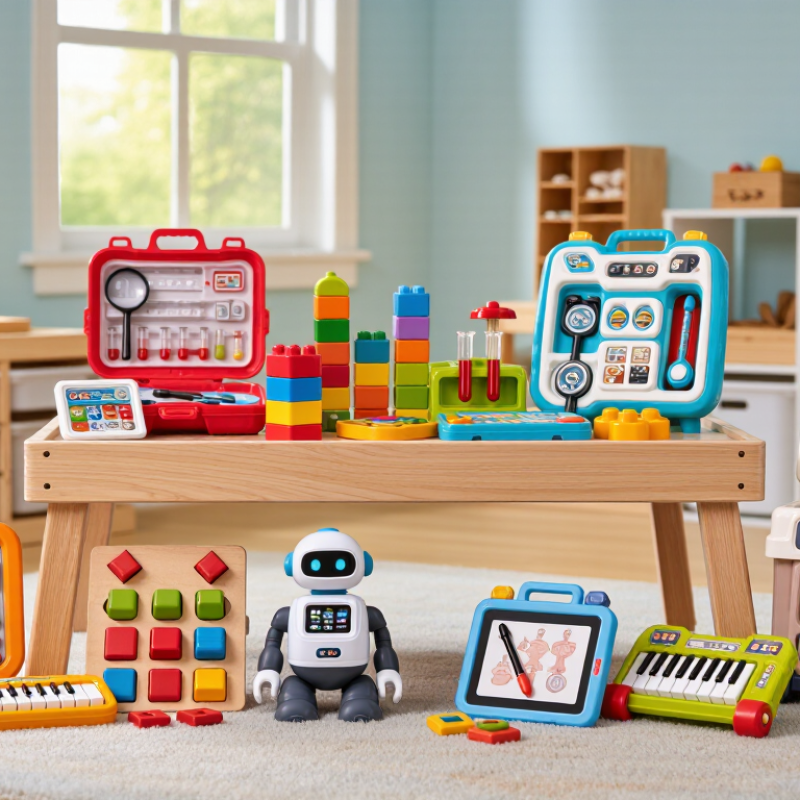
What Counts as a Learning Toy for Kids in 2026?
Top 10 Learning Toys for Kids in 2026?
What Counts as a Learning Toy for Kids in 2026?
A learning toy should invite a child to think, test, build, or communicate. It should not merely flash lights or repeat correct answers. In 2026, meaningful learning toys may combine physical play with carefully designed digital support. A child might arrange wooden pieces, hear a question, and change the design after a mistake. The toy should make that mistake useful. It should also suit the child’s age, abilities, language, and attention span.
Play remains central. I have seen children ignore impressive features when a toy feels confusing or too restrictive. Simple materials can create deeper learning when adults ask, “What could you try next?” Open-ended play encourages problem-solving, imagination, early mathematics, and cooperation. A strong toy offers more than one solution. It leaves room for surprise.
Technology needs careful limits. A connected toy should explain what information it collects and protect children’s privacy. Offline functions matter. So do durable materials, readable instructions, safe construction, and repairable parts. Experts should examine whether the toy supports real skills instead of measuring engagement alone. Parents can watch for active choices, repeated experiments, and conversations during play. I once judged a toy by its educational claims, then noticed children used it mainly as a noisy button board. That changed my standard. A learning toy must prove its value through children’s actions, not packaging language.
How to Evaluate Educational Value, Safety, and Age Fit
Choosing among the top learning toys for kids in 2026 takes more than reading the box. Look for a clear skill, such as sorting shapes, practicing early counting, or building hand control. Then watch how a child uses it. Do they try different approaches, or repeat one button press? A toy can claim to teach a lot and still offer little room to think. Check whether its instructions match the child’s reading and attention level. A puzzle with small steps may suit a young beginner better than a complicated kit that needs constant adult help.
Safety matters just as much as learning value. Check age guidance, small-part warnings, sturdy joins, and smooth edges. For toys with batteries, inspect the compartment and make sure it closes securely. Read care instructions, too; washable pieces can be useful after snack-time play. Age labels are helpful, not perfect. Children develop at different speeds, and I sometimes find that a toy labeled “easy” still frustrates a child who is tired or unfamiliar with the task. Stay nearby during first use, especially when pieces are small.
Tips: Before buying, picture the toy on your floor, not just in a product photo. Will pieces be easy to store? Can a child play without a screen or adult instructions? Try a simple test: ask the child to show you one new thing they discovered. If they can explain, demonstrate, or invent a variation, the toy may be encouraging active learning. If interest fades quickly, that is useful feedback too.
Learning Toys That Build Early Thinking and Language Skills
Top 10 Learning Toys for Kids in 2026?
Learning Toys That Build Early Thinking and Language Skills
The most useful learning toys invite children to do more than press a button. A set of chunky blocks can prompt sorting, counting, and rebuilding after a tower falls. Picture cards, pretend food, and simple puzzles give children reasons to name objects, ask questions, and explain what they are doing. Look for toys that match a child’s age and can be used in several ways. Open-ended play can be messy. That is part of the learning.
The American Academy of Pediatrics’ 2018 clinical report, “The Power of Play,” describes play as supporting language, social skills, and cognitive development. Harvard’s Center on the Developing Child also highlights responsive “serve and return” interactions: a child makes a sound or gesture, and an adult responds. A toy helps most when it sparks that exchange. For example, pause while building and ask, “Where should this piece go?” Then give the child time to answer.
Not every toy needs to teach a named skill. A small 2016 study in JAMA Pediatrics found that electronic toys were associated with fewer adult words and conversational turns than books and traditional toys during parent-infant play. The study was limited, so it should not be treated as a rule for every family. Still, a quiet toy and an engaged adult can be a strong combination. Some days, the child may ignore the puzzle and talk about the box. That counts, too.
Top 10 Learning Toys for Kids in 2026
Top 10 Learning Toys for Kids in 2026
In 2026, learning toys should invite children to touch, build, question, and revise. Grand View Research valued the global educational toy market at about $57.2 billion in 2023. It also projected a 10.8% compound annual growth rate through 2030. These figures show demand, not guaranteed learning outcomes. Parents still need to inspect design quality.
Strong choices include magnetic building tiles, wooden construction blocks, beginner coding robots, science experiment kits, math manipulatives, phonics games, geography puzzles, art-and-design sets, musical instruments, and cooperative board games. Building toys develop spatial reasoning through visible trial and error. Coding toys introduce sequencing without requiring long screen sessions. Math manipulatives make quantities easier to touch and compare. The best options allow several solutions.
Play matters beyond academic skills. The LEGO Foundation and UNICEF describe playful learning as active, engaging, meaningful, socially interactive, and iterative. That framework supports open-ended toys, especially when adults ask questions instead of giving answers. The American Academy of Pediatrics also recommends balancing digital media with sleep, movement, and family interaction. A coding robot may be useful. It may also become expensive clutter.
Check age suitability, choking risks, battery access, reading demands, and repairability. Avoid toys that promise instant intelligence. Evidence in this market remains uneven, and some claims sound stronger than the research. Observe the child: Does the toy encourage ten more minutes of thinking? That small test can reveal more than packaging.
Top 10 Learning Toys for Kids in 2026
The chart compares ten common learning-toy categories by the number of core learning domains they can support: language, numeracy, science, creativity, and problem-solving. Scores represent the number of applicable domains for each category.
Choosing the Right Learning Toy for Each Child
A useful learning toy meets a child where they are, not where an age label says they should be. Watch what holds their attention: stacking cups, pretend cooking, or fitting chunky shapes into a wooden board. A toddler who enjoys repeating one action may learn more from a simple cause-and-effect toy than a busy set with many buttons. For an older child, a basic building kit can invite planning, counting, and storytelling. Follow their curiosity.
Think about the skill you hope to encourage, then choose a toy that leaves room for the child to act. Puzzles support persistence when the pieces are challenging but manageable; picture cards can prompt conversation during a quiet afternoon. Check that parts suit the child’s age and that the toy is sturdy and easy to clean. A toy does not need to teach everything. Some play will wander, and that is normal. I have seen adults explain the “right” way to use a toy, only to find the child inventing a better game. Notice whether the child returns to it, asks questions, or becomes frustrated. That small observation can guide the next choice.