

For global foodservice operators, choosing a supplier is not just a catalog exercise. Commercial Kitchenware must withstand repeated washing, busy prep shifts, and sudden menu changes. A stockpot handle that loosens or a tray that warps can slow an entire service line. Small details matter. Buyers also need clear specifications, consistent quality checks, dependable lead times, and responsive after-sales support. Yet supplier pages rarely show the full picture. That gap deserves attention.
This guide to the 2026 Top Commercial Kitchenware Suppliers for Global Buyers offers a practical starting point, not a universal ranking. Supplier strengths vary by product range, order size, region, and customization needs. We consider factors buyers can verify, including material grades, production capabilities, sample availability, packaging, export experience, and documented quality processes. Ask for drawings, relevant test records, and written delivery terms before committing. Compare the thickness of a stainless-steel pan, the smoothness of its rim, and how securely its lid fits. Then confirm whether replacement parts and repeat orders are realistic. Costs can look attractive until freight, breakage, or minimum quantities enter the conversation. This part is often overlooked. No supplier is perfect, and public information may be incomplete or outdated. Treat the shortlist as a research aid; verify claims directly and match each option to your kitchen’s workload, budget, and service standards. A careful comparison takes time. It can prevent expensive surprises later.
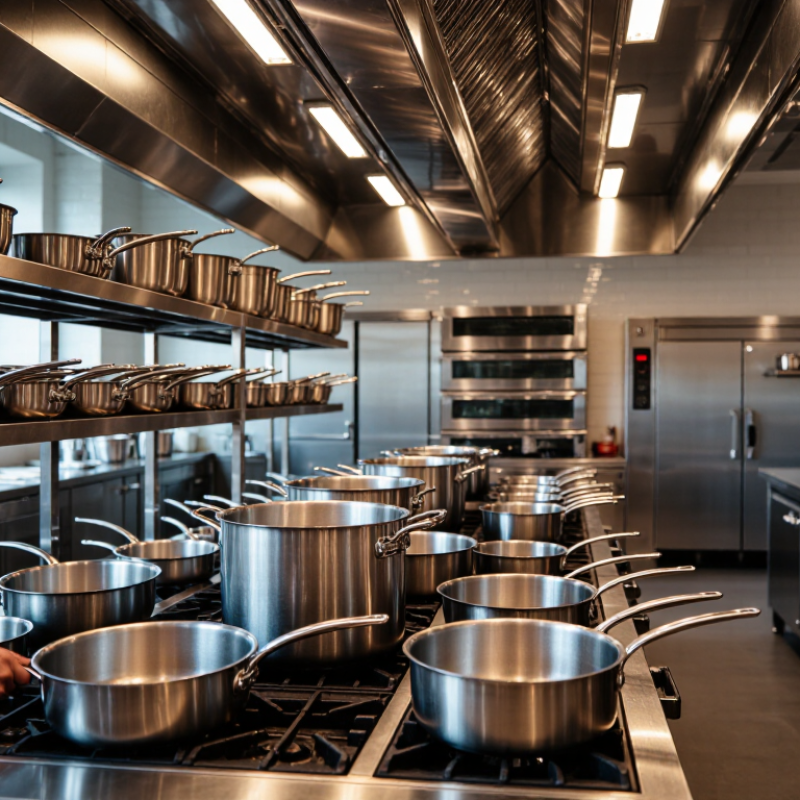
Commercial kitchenware covers the tools used to prepare, cook, store, and serve food. Typical items include stainless-steel pans, cutting boards, mixing bowls, ladles, food-storage containers, and serving trays. Some buyers also include small countertop equipment, though supplier catalogs define this boundary differently. Check product specifications rather than relying on category labels.
These products serve restaurants, hotels, caterers, institutional kitchens, and food-service distributors. A busy restaurant may need durable pans and fast-cleaning utensils for repeated shifts. A hotel kitchen often requires a broader range, from banquet serving pieces to storage containers for several preparation stations. Schools and healthcare facilities may prioritize easy handling, consistent portioning, and clear cleaning instructions. Details matter.
Buyers should match materials and dimensions to actual workflows. Stainless steel handles frequent use, while compatible food-grade plastics can help with storage and lighter tasks. Confirm capacity, temperature limits, cleaning guidance, replacement-part availability, and packing quantities before ordering. A sample can reveal awkward handles or lids that do not seal well—issues a product photo may miss. Price matters, but the cheapest set may wear out sooner. And specifications do not always reflect the realities of a crowded kitchen.

The National Restaurant Association’s 2025 State of the Restaurant Industry report forecasts $1.5 trillion in U.S. restaurant and foodservice sales for 2025. That is a striking figure. Yet a national forecast cannot promise steady traffic at every location. For global kitchenware suppliers, it signals a large market, not guaranteed orders.
The ENERGY STAR program reports that restaurants use roughly five to seven times more energy per square foot than other commercial buildings. That makes refrigeration, cooking, and warewashing choices consequential. Buyers can compare energy use, capacity, cleaning requirements, and service support before choosing equipment. A refrigerator that fits the floor plan but struggles during a busy dinner rush is no bargain.
Still, efficiency claims need scrutiny. Paper savings can disappoint. Supplier comparisons should use the same operating assumptions, especially for electricity costs and daily hours. A small detail matters: whether a replacement filter or fitting is readily available can affect downtime. The NRA forecast describes industry-wide sales, while each buyer’s menu, location, and kitchen workflow determine what equipment actually earns its space.
Global buyers evaluating commercial kitchenware suppliers should compare complete workflows, not isolated products. A cooking line may include ranges, ovens, and holding cabinets, yet its layout must allow staff to move safely. Request capacity figures, utility requirements, installation clearances, and spare-parts information in writing. These details show whether equipment suits a busy lunch rush or only looks suitable in a catalogue.
Preparation, refrigeration, and warewashing deserve equal attention. Check that prep tables offer enough usable space for trays and cutting boards. For refrigerators, compare temperature recovery, door access, and storage capacity under realistic loading. Warewashing choices should match dish volume, available space, and drying needs. A machine’s rated output may not reflect a crowded evening service. Even careful plans miss something; teams can underestimate how often doors, carts, and staff cross the same narrow aisle. Confirm specifications, review installation drawings, and ask how performance is tested before placing an order.
Tips: Measure doorways and service aisles on site. Request operating and cleaning instructions. Compare warranty terms and lead times, not just purchase prices. Keep a small allowance for layout changes; the first plan is not always the best one.
Global Supplier Landscape: Cooking, Preparation, Refrigeration, and Warewashing
| Product Category | Typical Commercial Products | Common Materials and Features | Relevant Standards to Check | Key Buyer Evaluation Points |
|---|---|---|---|---|
| Cooking Equipment | Ranges, ovens, griddles, fryers, steamers, and hot-holding equipment | Stainless-steel housings; gas or electric heating; model-dependent capacity, controls, and output | NSF/ANSI 4 may apply to commercial cooking and hot-food equipment. Electrical or gas approvals depend on the destination market and appliance type. | Confirm fuel type, voltage and phase, installation clearances, ventilation needs, service access, and availability of replacement parts. |
| Food Preparation | Mixers, food processors, slicers, vegetable cutters, work tables, and sinks | Food-contact surfaces commonly use stainless steel; removable components can support cleaning and maintenance | NSF/ANSI 2 covers food equipment; NSF/ANSI 51 addresses materials used in food equipment. Verify applicable local electrical and workplace-safety requirements. | Check food-contact materials, guarding and interlocks, batch capacity, cleanability, operating speed, and whether accessories are included. |
| Commercial Refrigeration | Reach-in refrigerators and freezers, undercounter units, prep tables, and display cases | Insulated cabinets, door gaskets, adjustable shelving, and mechanical or electronic temperature controls; refrigerant varies by model | NSF/ANSI 7 applies to commercial refrigerators and freezers. Confirm electrical, energy-efficiency, and refrigerant rules for the destination market. | Compare usable volume, temperature range, ambient operating conditions, defrost method, energy use, door configuration, and service requirements. |
| Warewashing | Undercounter, door-type, conveyor, and glasswashing machines; pre-rinse equipment | Stainless-steel wash chambers; model-dependent wash cycles, water consumption, and built-in or external chemical systems | NSF/ANSI 3 covers commercial warewashing equipment. Local plumbing, backflow-prevention, electrical, and sanitation rules may also apply. | Match throughput to peak demand; verify rack dimensions, water temperature and pressure requirements, drainage, chemical compatibility, and installation utilities. |
| Cookware and Bakeware | Commercial pots, pans, sheet pans, roasting pans, and food-service utensils | Common constructions include stainless steel, aluminum, and coated or uncoated metal; suitability depends on the cooking method and product design | Check applicable food-contact material rules in the destination market and request documentation for coatings or other food-contact surfaces. | Assess dimensions, thickness, handle construction, heat-source compatibility, cleaning instructions, and suitability for repeated commercial use. |
| Stainless-Steel Fixtures and Storage | Work tables, shelving, cabinets, sinks, and wall-mounted storage | Stainless-steel grades and finishes vary by component; welded construction and adjustable feet are common design features | NSF/ANSI 2 may apply to relevant food equipment. Confirm local requirements for sinks, drainage, and installation. | Request drawings and dimensions; check load capacity, finish, weld quality, edge treatment, assembly method, and packaging for transport. |
Buyer note: Standards and certification requirements vary by product, configuration, and destination market. Verify certificates against the exact model and confirm that required approvals are accepted where the equipment will be installed.
For global buyers, safety claims matter only when they match the equipment’s actual use. The FDA Food Code 2022 is a model code, not a single worldwide law; local authorities may adopt different editions or amendments. Its requirements offer concrete questions: can refrigerated units hold temperature-controlled foods at 41°F (5°C) or colder, and hot-held foods at 135°F (57°C) or hotter? These thresholds appear in sections 3-501.16 and 3-501.16(A)(1). Ask for test records under realistic loading, not just an empty-cabinet demonstration. Small details count.
NSF/ANSI 2 sets sanitation-related requirements for food equipment design and construction. Request the exact standard edition, certification scope, and model number; approval of one unit may not cover every configuration. Inspect corners, welds, drain points, and removable guards.
A polished brochure can hide a hard-to-clean seam. The FDA Food Code also specifies suitable characteristics for food-contact surfaces. Check that the installed equipment’s cleaning instructions match its materials and design.
The public-health stakes are substantial. The CDC’s 2011 estimate attributes about 48 million U.S. foodborne illnesses each year to contaminated food, alongside 128,000 hospitalizations and 3,000 deaths. These figures are not a supplier scorecard, but they show why hygienic design deserves scrutiny.
During audits, photograph equipment nameplates and verify local acceptance before shipment. Paperwork can still miss a rough weld; certification helps, but it cannot replace inspection.
For global buyers, an ENERGY STAR-qualified fryer can use about 35% less energy than a standard model. Treat that figure as a benchmark, not a guaranteed saving for every kitchen. Actual consumption depends on frying hours, menu volume, oil temperature, and idle time. A busy service line may see different results from a kitchen that fries only occasionally.
Ask suppliers for the fryer’s current ENERGY STAR qualification, rated power, oil capacity, and recovery-time data. Compare models with similar capacity and operating conditions; otherwise, the energy figures may mislead. Check voltage and frequency compatibility, available parts, and local service support before placing an order. Small details matter. A fryer that heats efficiently but waits weeks for a replacement thermostat can disrupt service.
During demonstrations, watch how quickly the oil returns to temperature after a basket is added. Ask how the unit manages heat during quiet periods, and whether its controls make standby settings easy to use. Request written test information behind the 35% comparison, including the standard model used. The paperwork may not answer every question. Supplier claims deserve a second look when usage assumptions are missing or unclear.
