



What Are the 2026 Top Solar Light Tower Types?
In 2026, Solar Light Tower technology is moving beyond simple outdoor illumination. Construction sites, emergency crews, road teams, and event operators now need cleaner, quieter, and more adaptable lighting. The best tower type depends on location, operating hours, weather, transport needs, and available sunlight.
Several designs deserve close attention. Mobile trailer towers offer broad coverage and easy relocation between work zones. Compact battery-supported models suit overnight security, small repairs, and temporary public services. High-mast LED towers provide stronger illumination across large areas, while hybrid solar towers can maintain output during cloudy periods. Some systems also include remote monitoring, adjustable panels, automatic dusk sensors, and lithium battery storage.
Field conditions matter. A tower with excellent specifications may perform poorly when its panels face dust, shade, or frequent storms. Operators should examine battery capacity, charging time, mast stability, light distribution, maintenance access, and verified safety testing. Real experience often reveals weaknesses that product brochures do not mention. For example, a tower may illuminate a wide yard but leave dark patches near equipment or access roads.
This overview compares the leading 2026 Solar Light Tower types through practical performance, energy efficiency, portability, durability, and total operating value. The market is improving, but not every innovation is equally useful. Some claims still require independent testing. That deserves attention. Reliable purchasing decisions should combine manufacturer data, field feedback, recognized certifications, and site-specific assessment.
Solar Light Tower Fundamentals and Core Components
What Are the 2026 Top Solar Light Tower Types?
Solar light towers convert sunlight into stored electrical power and usable nighttime illumination. Their core system includes photovoltaic panels, a battery bank, an LED lighting head, a mast, and a control unit. The panels produce direct-current electricity during daylight. The charge controller regulates energy flow and protects the battery from damaging voltage levels. At night, the battery powers efficient LED fixtures through an inverter or direct-current circuit.
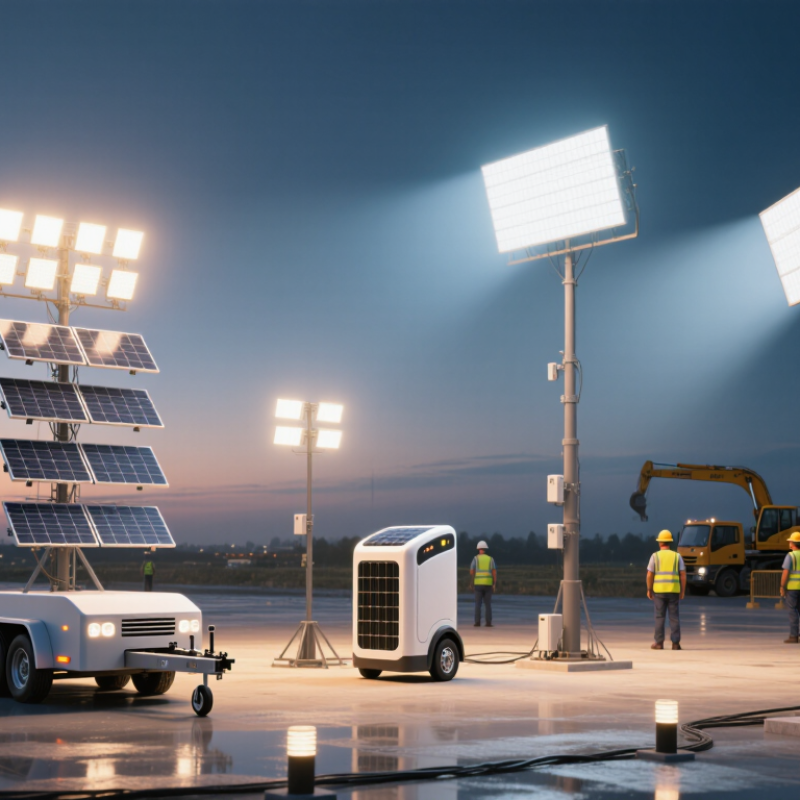
The main 2026 types include trailer-mounted towers, compact mobile towers, vertical-mast units, and solar-hybrid models. Trailer-mounted designs suit roadwork, outdoor events, and emergency areas because workers can reposition them with a vehicle. Compact towers fit narrow paths and smaller construction zones. Vertical masts usually provide broader coverage, but strong wind requires careful anchoring. Hybrid units add a backup generator or grid connection, which helps during long periods of rain.
Battery capacity is often more important than maximum lamp output. A bright tower may fail before dawn if its storage system is undersized. Lithium batteries usually offer strong cycle performance, while other battery chemistries can reduce initial costs. Weather sealing, thermal management, panel angle, and remote monitoring also affect reliability. Field inspections should check cable joints, mast locks, and battery temperature. Small faults matter.
My design reviews have shown that solar estimates can be overly optimistic. Dust, winter shadows, and repeated cloudy days reduce real output. A conservative energy calculation is safer than a perfect-weather assumption.
What Are the 2026 Top Solar Light Tower Types? - Solar Light Tower Fundamentals and Core Components
| Solar Light Tower Type | Typical Applications | Typical Solar Array | Typical Battery Storage | Lighting Configuration | Typical Operating Characteristics | Key Advantages |
|---|---|---|---|---|---|---|
| All-in-One LED Solar Tower | Construction areas, roadwork, events, parking areas and emergency lighting | Approximately 400–1,200 Wp of monocrystalline or polycrystalline PV modules | Approximately 2–10 kWh, commonly using lithium-ion or lithium iron phosphate batteries | LED floodlights mounted on a compact telescopic mast; often 2–4 light heads | Usually designed for dusk-to-dawn operation with automatic photocell control and battery-based overnight autonomy | Compact layout, relatively simple installation, low operating noise and no routine fuel consumption |
| Trailer-Mounted Solar Light Tower | Large construction sites, utility projects, temporary work zones and outdoor infrastructure maintenance | Approximately 800–2,400 Wp, frequently arranged on folding or deployable panels | Approximately 5–20 kWh, depending on lighting load and required autonomy | Four adjustable LED fixtures on a hydraulic or manual telescopic mast | Trailer chassis supports towing, leveling jacks and deployment at multiple locations; operating time depends on solar resource and load | High mobility, larger panel area and good coverage for extended work zones |
| Vertical Mast Solar Tower | Mining sites, military or disaster-response areas, ports, rail yards and high-mast illumination | Approximately 600–2,000 Wp, with panels positioned around or beside the mast | Approximately 4–16 kWh | High-mounted directional LED luminaires, commonly 2–6 fixtures | Mast heights commonly range from about 5–12 m; higher mounting improves light distribution but increases wind-load requirements | Broad illumination area and improved light uniformity for large open spaces |
| Hybrid Solar-Battery Light Tower | Critical work sites, locations with variable sunlight, winter operations and high-availability lighting | Approximately 600–2,000 Wp | Approximately 5–25 kWh, often based on lithium iron phosphate chemistry | High-efficiency LED floodlights with dimming and programmable lighting schedules | May include grid input or a backup generator connection; energy management prioritizes solar charging and battery use | Greater resilience during cloudy periods and more predictable service availability |
| Fixed Solar Lighting Tower | Permanent parking facilities, public spaces, logistics yards, campuses and remote access roads | Approximately 200–1,000 Wp, sized according to local solar irradiation and lighting demand | Approximately 1–10 kWh | One or more fixed LED luminaires mounted on a permanent pole or structure | Requires engineered foundation, wind-load assessment and planned access for battery or controller maintenance | Long-term installation, minimal cabling and reduced need for trenching or grid extension |
| Foldable-Panel Solar Tower | Temporary events, rental fleets, disaster relief and sites requiring compact transport | Approximately 500–1,500 Wp using hinged or sliding PV panels | Approximately 3–12 kWh | Two or four LED floodlights, typically adjustable for area or perimeter coverage | Panels fold inward for transport and deploy when the unit is positioned; stabilizers are required during operation | Efficient transport profile, rapid deployment and increased solar collection area when opened |
Core Components and Typical Specifications
| Component | Primary Function | Common Technical Range | Important Design Considerations |
|---|---|---|---|
| Photovoltaic Modules | Convert sunlight into direct-current electricity | Monocrystalline or polycrystalline modules; system capacity commonly 200–2,400 Wp | Tilt angle, shading, dust, orientation, temperature and local solar irradiation affect energy yield |
| Battery Bank | Stores solar energy for nighttime and low-sunlight operation | Commonly 1–25 kWh; lithium-based batteries provide high usable energy density | Usable capacity, depth of discharge, temperature control, cycle life and battery safety protection are critical |
| LED Light Heads | Provide efficient area or directional illumination | Commonly 50–300 W per light head; color temperatures often range from 3,000–6,500 K | Lumen output, beam angle, glare control, color rendering and ingress protection influence lighting quality |
| Charge Controller | Regulates PV charging and protects the battery from overcharging or excessive discharge | PWM or MPPT control; MPPT is generally preferred where PV voltage and operating conditions vary | Controller voltage, current rating, thermal protection and compatibility with the battery chemistry must be matched |
| Telescopic Mast | Raises light heads to improve coverage and mounting height | Portable systems commonly use approximately 5–12 m mast heights | Wind loading, raising mechanism, locking system, corrosion resistance and maintenance access are essential |
| Control and Monitoring System | Automates lighting schedules and provides operating-status information | Photocell, timer, motion sensor, dimming control and optional remote monitoring | Controls should support low-voltage protection, fault alerts and adjustable lighting profiles |
| Chassis, Trailer and Stabilizers | Provides mobility, structural support and stability during operation | Configurations include skid bases, towable trailers, outriggers and leveling jacks | Gross weight, towing requirements, ground conditions, braking and deployment time affect site suitability |
Note: Specification ranges are representative planning values. Actual performance depends on solar resource, load profile, battery condition, lighting schedule, ambient temperature and installation conditions.