



Why Choose Golf Range Mats for Commercial Facilities?
Commercial golf facilities face constant pressure from heavy play, changing weather, and demanding customer expectations. Golf Range Mats offer a practical surface for driving ranges, teaching bays, and indoor practice areas. They create a consistent hitting position when natural turf becomes worn, muddy, or uneven. The difference is visible. A player can stand securely, align the clubface, and repeat a swing without searching for a clean patch of grass.
From an operational perspective, quality mats can reduce turf recovery demands and keep practice areas open during wet seasons. Facility managers often evaluate pile density, shock absorption, drainage, UV resistance, and anchoring systems before purchasing. These details matter beside a busy ball dispenser, where thousands of swings may occur each week. Professional installers also check the base beneath each mat. A durable surface cannot correct poor drainage or an unstable foundation.
Still, the choice is not automatic. Not every mat fits every facility, and low-cost products may feel rigid or wear quickly. Some golfers dislike artificial surfaces, especially when they expect a premium outdoor experience. Regular brushing, cleaning, inspection, and replacement planning remain essential. A mat can hide poor maintenance for a while, but it cannot solve every safety concern. The best decision comes from observing real traffic, consulting experienced suppliers, and comparing long-term performance rather than focusing only on the initial price. For commercial owners, Golf Range Mats are not simply flooring. They are part of the facility’s playing experience, maintenance strategy, and professional reputation.
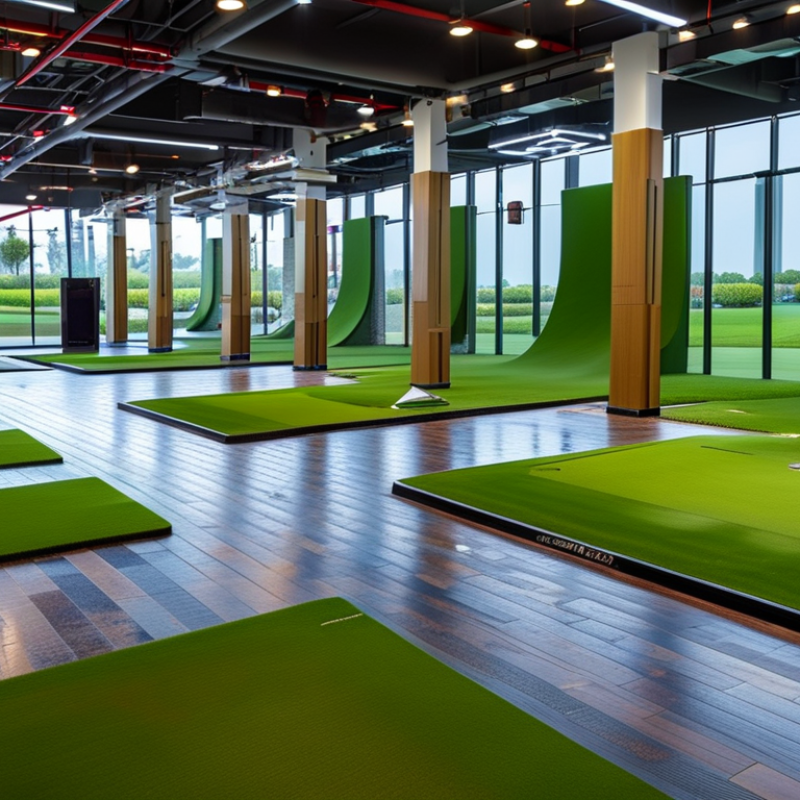
What Are Golf Range Mats in Commercial Facilities?
In commercial golf facilities, golf range mats are engineered hitting surfaces placed beneath tee stations. They usually combine synthetic turf, a rubber or foam base, and replaceable hitting inserts. Their purpose is practical: provide a consistent lie while protecting natural grass from heavy foot traffic and repeated club strikes. They are not simply outdoor carpets.
The National Golf Foundation reported that 45.0 million Americans played golf on-course or off-course in 2023. The R&A’s Golf Around the World 2023 report counted more than 61,000 golf facilities worldwide. That participation creates constant demand for durable practice areas. A well-designed mat should resist flattening, drain rainwater, and remain stable during repeated swings. Its surface should also provide realistic resistance without forcing golfers to change their normal contact pattern.
Daily inspection matters. Staff should check exposed seams, loose edges, worn inserts, and water beneath the base. Wear still happens. Some operators focus too heavily on the lowest purchase price. Replacement labor, downtime, and uneven hitting conditions can cost more later. Mats also cannot solve poor drainage or unsafe station spacing. Those issues require facility-level planning. Product testing under local weather conditions remains important, because a surface that performs well indoors may harden, fade, or shift outdoors. Sources: National Golf Foundation, 2023 participation data; The R&A, Golf Around the World 2023.
Why Choose Golf Range Mats for Commercial Facilities? - What Are Golf Range Mats in Commercial Facilities?
A practical comparison of golf range mat configurations, performance factors, and facility-planning considerations.
| Data Dimension | Standard Hitting Mat | High-Traffic Commercial Mat | Portable or Training Mat | Commercial Facility Relevance |
|---|---|---|---|---|
| Definition | A synthetic turf surface designed to provide a consistent stance and ball-striking area for golf practice. | A reinforced mat system intended for frequent daily use at driving ranges, golf academies, and entertainment venues. | A lighter, movable mat used for lessons, demonstrations, temporary bays, or flexible practice areas. | Mats create a uniform hitting surface where natural grass would become damaged or uneven. |
| Typical Overall Size | Approximately 1.2–1.5 m wide × 1.5–2.0 m long. | Approximately 1.5–2.0 m wide × 1.5–2.5 m long, depending on the bay layout. | Approximately 0.9–1.5 m wide × 1.2–1.8 m long. | The selected size should preserve golfer clearance, club swing space, and safe circulation between adjacent bays. |
| Common Turf Thickness | Usually about 15–25 mm for the synthetic turf layer and backing system. | Often about 20–35 mm, with additional shock-absorbing layers or a dense rubber base. | Often about 10–20 mm to reduce weight and simplify handling. | Greater thickness can improve comfort and stability, but it may increase cost, weight, and installation height. |
| Base Construction | Synthetic turf bonded to a rubber or resilient foam backing. | Dense rubber, multi-layer foam, or modular base designed to resist movement and repeated impact. | Lightweight rubber, foam, or interlocking modular construction. | A stable base reduces sliding, curling, and trip hazards during repeated swings. |
| Hitting Surface | Short, dense synthetic fibers intended to provide a consistent lie. | Dense, wear-resistant fibers with a replaceable or repairable hitting section in some configurations. | Synthetic turf optimized for portability and basic practice use. | Consistent turf reduces variation caused by worn grass, mud, or uneven ground. |
| Tee Options | Usually supports rubber tees or removable tee holders. | May include several tee positions, replaceable tee inserts, and left- or right-handed layouts. | Usually uses one or more removable rubber tees. | Multiple tee positions distribute wear and allow different golfer orientations. |
| Drainage Requirement | Requires a level, well-drained subfloor or permeable installation area. | Should be installed over a properly graded surface with drainage that prevents standing water. | Can be moved indoors or stored during heavy rain, but the surface beneath still needs to remain dry and stable. | Good drainage helps prevent odor, algae, frost damage, backing deterioration, and unsafe slipping. |
| Expected Traffic Level | Moderate use in practice areas, teaching bays, or smaller facilities. | High and repeated use in busy driving ranges and commercial hitting bays. | Light to moderate use with regular repositioning or storage. | Traffic level should determine fiber density, backing resilience, anchoring, and replacement planning. |
| Maintenance Activities | Regular brushing, debris removal, inspection of tee holders, and occasional cleaning. | Frequent brushing and cleaning, drainage checks, seam inspection, and planned replacement of worn sections. | Shake or vacuum debris, dry after wet use, and store flat or rolled according to the construction requirements. | Preventive maintenance preserves traction, appearance, safety, and the consistency of ball contact. |
| Main Commercial Benefits | Consistent practice conditions, quick installation, and reduced dependence on natural grass. | Improved durability, reduced turf recovery time, predictable bay appearance, and easier maintenance scheduling. | Flexible layouts, easy relocation, and useful support for lessons or temporary events. | Mats can help facilities operate more consistently across different weather and usage conditions. |
| Key Selection Criteria | Size, turf density, shock absorption, tee compatibility, and subfloor condition. | Daily user volume, replaceable components, drainage, anchoring, safety clearance, and lifecycle cost. | Weight, storage requirements, portability, grip, and ease of setup. | Selection should match the facility's operating hours, climate, bay design, golfer volume, and maintenance resources. |
| Recommended Application | Golf instruction areas, moderate-use driving ranges, and indoor practice spaces. | Busy commercial driving ranges, golf academies, resort practice facilities, and high-use entertainment venues. | Mobile coaching, demonstrations, event areas, home-to-commercial training, and temporary installations. | Choosing the correct configuration improves user comfort, operational reliability, and long-term value. |
Planning note: Dimensions and thicknesses shown are typical commercial planning ranges rather than universal specifications. Actual performance depends on turf construction, backing materials, subfloor preparation, climate, installation method, maintenance, and daily traffic. All metric conversions use 1 inch = 25.4 mm and 1 foot = 0.3048 m.