
Buying plastic recycling equipment is not simply a machinery decision. It is a production, quality, and risk decision.
The OECD’s Global Plastics Outlook reported that the world generated 353 million tonnes of plastic waste in 2019. Only 9% was recycled. That gap creates opportunity, but it also exposes weak purchasing decisions. A low-cost granulator may look attractive on a quotation sheet. However, its output can suffer when film, moisture, labels, or metal contamination enter the line.
The details matter.
A serious buyer should examine feedstock composition, hourly throughput, energy use, maintenance access, and final pellet specifications. UNEP’s Turning off the Tap report states that plastic pollution could be reduced by 80% by 2040 through system-wide changes, including better recycling and improved product design. Equipment alone cannot deliver that result. Operators, suppliers, and material testing must work together.
This guide presents 10 practical tips for selecting plastic recycling equipment. It considers washing systems, shredders, extruders, filtration, automation, and safety features. It also asks uncomfortable questions: Is the quoted capacity based on clean laboratory material? Can local technicians repair the drive system? What happens when contaminated feedstock arrives on Monday morning?
Those questions are not dramatic. They are practical.
Experience from recycling plants shows that the cheapest machine can become the most expensive asset after repeated downtime. Buyers should request test runs using their own material, inspect reference installations, and verify performance data independently. Industry reports provide useful direction, but site-specific testing remains essential. Estimates vary. Real plastic rarely behaves like a brochure sample.
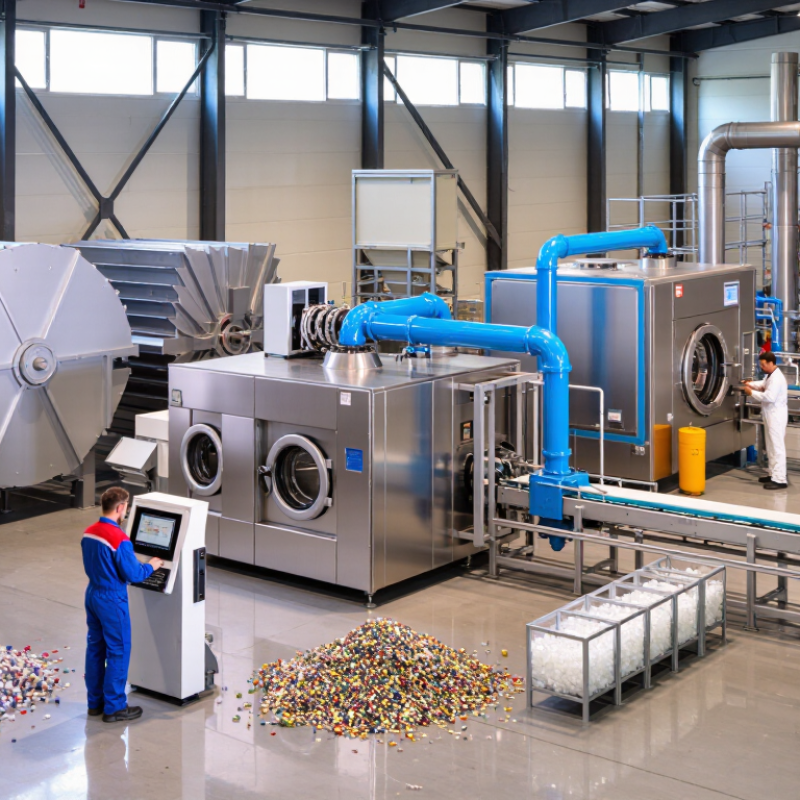
Define the job before comparing machines. A recycling line is not a shopping-list item. Start with the feedstock: PET bottles, PP film, HDPE containers, or mixed post-consumer plastics. Each stream carries different moisture, labels, additives, and contamination risks. The OECD’s Global Plastics Outlook reports that only 9% of plastic waste was recycled globally in 2019. That figure is a warning. Poor sorting can undermine expensive equipment.
Write measurable processing targets. Record hourly input, operating hours, acceptable downtime, flake size, moisture, and final pellet quality. Do not confuse rated capacity with usable capacity. Real throughput falls when film wraps shafts or dirty bales clog screens. Test a representative sample. Measure melt flow, moisture, ash, and black speck levels before selecting shredders, washers, extruders, and filtration systems. Plastics Europe reported global plastics production at 400.3 million tonnes in 2022, showing how varied the incoming material can be.
Budget for utilities, labor, spare screens, wastewater handling, and cleaning time. A line that consumes excessive water may appear efficient on paper, then strain daily operations. Ask for trials using your own material, not clean laboratory pellets. Request energy and output records from comparable applications. I would leave room for uncertainty; feedstock changes by season and supplier. Some assumptions will fail. Document rejected loads, manual sorting time, and unexpected stoppages during pilot testing. These details often reveal the real processing requirement.
Choosing recycling equipment starts with the plastic stream, not the machine catalogue. Identify whether you handle rigid containers, films, fibers, or mixed post-industrial scrap. Each material behaves differently during shredding, washing, drying, and extrusion. A slow-speed shredder may suit bulky containers, while a granulator can produce more uniform flakes. Film often needs specialized feeding control because it wraps around rotating parts.
Check real throughput, not only the advertised capacity. Ask for output figures using material similar to yours. Moisture, labels, dirt, and mixed polymers can reduce production sharply. A line rated for 800 kilograms per hour may process far less after washing and sorting. Measure twice. Review motor load, maintenance access, power demand, and available floor space. These details affect daily operating costs.
Material compatibility deserves careful testing. PET, HDPE, PP, and multilayer films require different temperature ranges and filtration methods. Request a trial using your actual feedstock. Inspect pellet appearance, moisture levels, odor, and contamination after processing. Confirm that screens, screws, cutters, and seals match the expected polymer and additives. I have seen buyers focus on output speed and overlook cleaning time. That decision can create avoidable downtime. Some specifications also look precise but depend heavily on operator skill and feed consistency. Leave room for that uncertainty when comparing suppliers and planning capacity.
Check energy efficiency with measured data, not attractive brochure claims. Ask for energy use per processed ton at your planned throughput. A machine using less power during idle periods can reduce daily waste. Review motor ratings, heating zones, cooling systems, and variable-speed controls. Small savings become significant across continuous shifts. Request test results under material conditions similar to yours.
Automation should improve control without making operators dependent on guesswork. Look for sensors that monitor temperature, pressure, moisture, and material flow. Clear alarms can prevent poor output before a full batch is affected. Data logging also helps maintenance teams identify repeated faults. Keep controls understandable. Overly complex screens may slow response during a busy shift. A practical trial is valuable. Run mixed feedstock, interruptions, and restart procedures before purchasing.
Operational safety deserves equal attention. Inspect guarding, emergency stops, access doors, and heat protection around every service area. Confirm that isolation procedures are clear and documented. Operators should reach controls without standing near moving parts. Ask how cleaning, blade changes, and jam removal are performed. These tasks often expose weaknesses that normal production hides. One lesson is easy to overlook: automation does not replace training. It can create new risks when settings are changed without permission. Check maintenance access, spare-part availability, and staff instruction records. Leave room for improvement. No evaluation is perfect, and a second site visit may reveal details missed during the first inspection.
10 Tips for Buying Plastic Recycling Equipment
Equipment quality is more than a shiny frame. OECD’s Global Plastics Outlook reports that only 9% of plastic waste was recycled globally in 2019. Reliable machinery can help reduce avoidable losses. Tip 1: Test your actual feedstock, including wet film, labels, and dusty containers. Tip 2: Inspect rotor balance, knife hardness, screen design, and melt filtration. Tip 3: Request output samples with measured moisture, contamination, and pellet consistency. Tip 4: Check energy use per processed tonne, not only the motor’s rated power.
Maintenance details often decide whether a machine earns its place. Tip 5: Ask for cleaning access around the chamber, screen, and extruder. Tip 6: Confirm replacement-part availability for bearings, blades, heaters, and seals. Tip 7: Demand a written maintenance schedule with inspection intervals. The U.S. Department of Energy reports that predictive maintenance may reduce maintenance costs by 25–30% and downtime by 35–45%. That figure is useful, but real results depend on operator discipline.
Supplier support needs proof. Tip 8: Set response-time targets for technical problems and emergency parts. Tip 9: Check whether training covers start-up, shutdown, troubleshooting, and safe isolation. Tip 10: Speak with operating plants, not only sales references. A perfect demonstration can mislead. I have seen specifications hide difficult cleaning work. Ask for a factory acceptance test, service records, and clear warranty exclusions. Compare the total five-year cost, including electricity, labor, consumables, and lost production.
Buying plastic recycling equipment requires more than comparing purchase prices. Calculate the total cost across installation, freight, utilities, training, maintenance, spare parts, and downtime. A low-priced machine may need costly electrical upgrades or building changes. My first estimate was wrong because I ignored water treatment and operator training.
Ask for measured energy consumption at your expected throughput. Check whether the equipment can process your actual plastic mix, including moisture, labels, and contamination. Request test results, maintenance schedules, and realistic output rates. Speak with experienced operators, not only sales teams. Their daily observations often reveal noise, cleaning time, and access problems. Small details matter.
Compliance costs deserve careful attention. Confirm local requirements for fire protection, electrical safety, emissions, wastewater, worker protection, and waste storage. Keep written records of inspections and technical documents. Requirements can differ between regions and may change over time. Build a contingency budget of at least ten percent. It may still be insufficient. Long-term return depends on stable output, saleable material quality, labor efficiency, and repair response. Compare expected annual profit with the complete five-year cost, not the invoice alone. Include lost production during failures. A reliable machine with higher efficiency may deliver stronger returns than cheaper equipment. Yet projected savings are not guaranteed; test assumptions with actual material samples and conservative production figures.
| No. | Buying Tip | What to Evaluate | Typical Planning Data | Compliance and Operating Requirements | Long-Term Return Indicator |
|---|---|---|---|---|---|
| 1 | Define the feedstock before choosing the machine | Record polymer type, moisture, contamination, color, bulk density, particle size, and the percentage of films, rigid plastics, labels, and metals in the incoming material. | A representative sample and laboratory or supplier testing commonly costs approximately US$500–US$5,000, depending on test complexity. | Waste classification, storage controls, and acceptance criteria should be documented before material is received. | Better feedstock data reduces oversizing, premature wear, unstable output, and rejected recycled material. |
| 2 | Match capacity to available supply | Compare guaranteed throughput with the actual monthly supply. Allow for maintenance, changeovers, cleaning, holidays, and inconsistent incoming volumes. | A practical planning assumption is 70%–85% utilization of nominal operating hours rather than 100% nameplate capacity. | Confirm that storage areas, traffic routes, fire protection, and noise controls can support the intended throughput. | Avoiding a machine that sits idle generally protects capital efficiency better than selecting the largest available capacity. |
| 3 | Calculate the complete purchase cost | Include the main machine, shredding or grinding, washing, drying, extrusion, pelletizing, conveyors, sorting, magnets, installation, commissioning, training, and spare parts. | Installation, commissioning, and integration can add approximately 10%–30% to equipment purchase cost; site modifications may be additional. | Confirm electrical, water, drainage, ventilation, wastewater, foundation, lifting, and building requirements before signing the order. | Use total installed cost, not equipment price alone, when calculating depreciation, financing, and payback. |
| 4 | Measure energy and utility consumption | Request rated power, actual average power, water demand, compressed-air demand, heating load, and expected consumption per tonne of finished product. | Energy cost should be calculated as: kWh per tonne × local electricity price × annual tonnes processed. | Check electrical protection, motor efficiency, thermal safety, water discharge limits, and local restrictions on wastewater release. | A lower purchase price can be offset by higher energy, water, labor, or wastewater-treatment costs over the equipment life. |
| 5 | Verify product quality and yield | Ask for a material trial using representative feedstock and measure output rate, moisture, ash, contamination, color, melt-flow properties, and pellet consistency. | Material yield is feedstock-dependent. Build the business case using measured yield, including expected losses from dirt, labels, moisture, and non-target polymers. | Product specifications may need documented testing for customer requirements, food-contact restrictions, chemical content, or recycled-content claims. | The relevant revenue figure is saleable tonnes, not input tonnes. A higher yield can materially improve margin without increasing installed capacity. |
| 6 | Check local permits and environmental rules | Identify permits for waste handling, air emissions, wastewater, noise, fire safety, construction, electrical work, and occupational health before installation. | Permit fees and professional studies vary by jurisdiction. Allow a separate budget for engineering, sampling, legal review, and authority application fees. | Requirements differ by country, state, province, and municipality. Obtain written confirmation from the relevant authorities rather than relying on a generic supplier statement. | Early compliance planning reduces the risk of delayed commissioning, operating restrictions, fines, or costly retrofits. |
| 7 | Compare labor and maintenance requirements | Assess operator count, skill level, cleaning frequency, blade and screen changes, filter replacement, lubrication, wear parts, troubleshooting, and remote support. | Annual maintenance planning is often modeled at approximately 2%–8% of installed equipment cost, depending on process severity and automation. | Require machine guarding, lockout/tagout procedures, emergency stops, dust controls, training records, and documented preventive maintenance. | Higher automation may reduce labor and quality variation, while simple access to wear parts can improve uptime and reduce production losses. |
| 8 | Review supplier guarantees and service support | Put throughput, product quality, energy limits, noise levels, installation scope, acceptance testing, warranty terms, and response times into the contract. | Keep a working-capital reserve for initial spare parts, consumables, commissioning material, operator training, and unexpected start-up adjustments. | Request technical files, conformity documentation, safety instructions, electrical diagrams, risk assessments, and operating manuals applicable to the installation location. | A measurable acceptance test links payment to actual performance and helps protect the projected payback period. |
| 9 | Model market revenue conservatively | Use realistic selling prices for the recycled product and separately model income from recovered metals, by-products, avoided disposal fees, and possible processing fees. | Sensitivity analysis should include at least ±20% changes in selling price, feedstock cost, output yield, energy price, and annual operating hours. | Ensure environmental claims and recycled-content statements are supported by records, traceability, and the rules applicable to the target market. | Calculate: annual gross margin = product revenue + avoided costs − feedstock − utilities − labor − maintenance − disposal. |
| 10 | Calculate payback and lifecycle return | Compare total installed cost, financing, working capital, depreciation, operating expenses, downtime, residual value, and replacement costs over the planned service period. | Simple payback is calculated as: total initial investment ÷ annual net cash benefit. Use discounted cash flow for a more complete investment decision. | Include future regulatory upgrades, monitoring, reporting, insurance, permit renewals, and decommissioning obligations where applicable. | Approve the project only after testing conservative, expected, and optimistic scenarios. A short payback under one scenario alone is not sufficient evidence of long-term profitability. |